How To Apply for Pag IBIG Housing Loan: A 8-Step Guide to Getting Approved
This guide is written with the assumption that you’re already a member of the Pag IBIG fund. If you’re not one yet, register now so you can avail of the Pag IBIG housing loan and enjoy other member-exclusive benefits.
You should also be aware that there are two modes of applying for the Pag IBIG housing loan:
- Developer-Assisted where the developer helps you with the application; and
- Retail in which the member applies for the housing loan on his/her own.
The procedures below are intended for the “Retail” applicants who want to avail of the housing loan unassisted.
1. Check if You’re Eligible To Apply for the Pag IBIG Housing Loan
The Pag IBIG housing loan program is available to anyone with the following qualifications:
a. An active Pag IBIG Fund member with 24 months worth of contributions at the time of application
New members who have been paying contributions for at least 12 months can also complete the required amount of contributions through lump-sum payments.
Members who have contributed for at least two years and whose housing loans exceed ₱500,000 will be required to pay the upgraded membership contribution rates upon approval of the said loan and onwards.
Related Article: Pag-IBIG Contribution Table (with Detailed Computations and Explanations)
b. Not more than 65 years old at the time of loan application and not more than 70 years old at loan maturity
Remember, the maximum loan period is 30 years.
For senior applicants, your loan period is determined by how close your age is to the maximum age of 70. For example, if you’re 50 years old at the time of application, your maximum loan period is only 20 years because you’ll be turning 70 by the time the period ends.
c. With a legal capacity to acquire and encumber the real property.
d. Has passed the background checks (credit/employment/business, etc.) conducted by the Pag IBIG Fund.
e. No previous Pag IBIG housing loan that ended up with the borrower’s property being foreclosed, brought back to default, canceled, or surrendered (dación en pago).
f. If with existing Pag IBIG housing loan or Short Term Loan (STL), either as principal borrower or co-borrower, payments must be updated (READ: Can a Pag IBIG member apply for multiple/additional housing loans?)
2. Know Your Purpose for Applying for the Pag IBIG Housing Loan
Contrary to popular belief, a Pag IBIG housing loan isn’t only used to finance the construction of a new house.
The loan can support you financially if you’re planning to do one of the following:
- Buy a fully-developed residential lot or adjoining residential lots not exceeding 1,000 sq.m.
- Buy a residential house and lot, condominium unit, or townhouse (inclusive of the parking lot). The property can be new, old/pre-owned, an acquired asset of the Pag-IBIG Fund, or adjoining houses and lot/condominium units/rowhouses/townhouses (cost of transfer is included)7.
- Build or construct a residential unit on a residential lot owned either by you or a relative.
- Give your home a major repair or overhaul. Take note that Pag-IBIG offers two options to finance home improvement. The Pag IBIG housing loan is intended for homes that need more serious and costly repairs. For minor home improvement or renovation, you can avail of the Pag IBIG Multi-Purpose Loan instead.
- Refinance an existing housing loan provided that the institution you borrowed the money from is acceptable to Pag IBIG and that your account is updated at least 1 year upon application as supported by official receipts and a Statement of Account.
Pag IBIG also allows borrowers to avail of the housing loan for a combination of the above-mentioned purposes. However, the combinations are limited to the following:
- Buy a fully-developed lot not exceeding 1,000 sq.m. + Build a residential unit on the said lot.
- Buy a residential unit (old or new) + Home improvement.
- Refinance an existing housing loan or mortgage + Home improvement.
- Refinance an existing loan for the purchase of a lot + Build a residential unit on the same lot.
Lastly, Pag IBIG can also finance one or more of the loan purposes as well as the transfer of the title. The combinations are limited to the following:
- Buy a residential unit + Transfer the title to the borrower.
- Buy a residential unit + Home improvement + Transfer of title to the borrower.
- Buy a residential lot + Transfer of title to the borrower.
- Buy a residential lot + Build or construct a house/residential unit + Transfer of title to the borrower.
3. Choose the Pag IBIG Housing Loan Program That Matches Your Current Income Level
Unlike banks in the Philippines, Pag IBIG Fund offers two programs tailored to the borrower’s capacity to pay:
a. Affordable Housing Loan Program for Minimum Wage and Low-Income Earners
This is exclusively offered to low-income or minimum-wage earners
The applicable maximum loanable amount and interest rates depend on the income cluster to which the member belongs8. Members earning not exceeding PHP 15,000 within NCR or PHP 12,000 outside NCR belong to Cluster 1. Meanwhile, members earning not exceeding PHP 17,500 within NCR or PHP 14,000 outside NCR belong to Cluster 2.
Cluster 1 members can enjoy a loanable amount not exceeding the socialized housing loan ceiling set by Pag-IBIG (the current ceiling is at PHP 580,000) with a 3% interest rate for the first five years of the loan term. Meanwhile, cluster 2 members can enjoy a loanable amount of up to PHP 750,000 with a 6.5% interest rate for the first ten years of the loan term.
b. Regular Housing Loan Program
This is for applicants with above-average gross monthly income. Under this program, qualified applicants can borrow up to ₱6 million with an interest rate of as low as 5.750%9 (one-year fixed pricing period).
To determine how much you can borrow from the Regular Housing Loan Program, Pag IBIG uses the following criteria:
- Your actual need;
- Your desired loan amount;
- Your current income, which suggests your capacity to pay;
- The loan-to-appraised value ratio.
After determining the value of each criterion above, Pag IBIG will pick the lowest value and declare it the loanable amount
Alternatively, you can also use the Pag-IBIG Fund Housing Loan Affordability Calculator, which gives you an estimate of how much you can borrow based on your desired loan amount, preferred repayment period, and preferred fixed pricing period.
It’s located at the bottom right corner of the page.
Note, however, that the online calculator is only used as a guide. The actual loanable amount will vary depending on the results of Pag IBIG’s evaluation.
c. Pag-IBIG Home Equity Appreciation Loan (HEAL)
This is open for members with commendable loan payment records. Under this program, qualified members may borrow an amount based on their mortgaged property’s net value. Loaned amount from Pag-IBIG HEAL can be used not only for home improvement purposes but also for education expenses, acquisition of appliances, and other life goals 10.
The applicable interest rate is based on the chosen period but is set lower as an incentive for good-paying members.
The maximum loanable amount is the difference between 6 million pesos and the remaining balance of your existing Pag-IBIG Housing loan. However, this is still subject to other considerations, such as the capacity to pay and the preferred loan amount.
d. Pag-IBIG Acquired Assets Program
A property becomes a Pag-IBIG acquired asset11 or a foreclosed property after a person fails to repay its Pag-IBIG housing loan. Pag-IBIG “resells” these properties through public bidding to recover its loss.
Acquired assets12 are sold at a cheaper price, making them attractive to low-earners or those with tight budgets.
Buyers of acquired assets may purchase them through cash or on an installment basis. Paying on an installment basis makes it similar to a housing loan since you have to pay on a regular basis with interest accruing per period. You can pay through short-term installments, with 6.375% interest, and must be paid within a year, or through long-term installments.
You can find foreclosed properties available for public bidding on the Pag-IBIG Acquired Assets webpage. Scroll down to see the schedule of public auctions.
4. Complete All the Pag IBIG Housing Loan Requirements
Applicants must submit two sets of fees and requirements–one during the loan application and another upon or before loan release. For more information, please jump to the previous section containing the Pag IBIG housing loan requirements.
5. Submit All Housing Loan Requirements to Pag IBIG
There are two ways to do this: through online scheduling or by applying over the counter at the nearest Pag IBIG branch.
Option 1: Online Application
The Pag-IBIG Fund has officially launched the new Virtual Pag-IBIG, an online portal where members can easily complete different transactions – from housing loan applications to payment of contributions – in the comfort of their own homes.
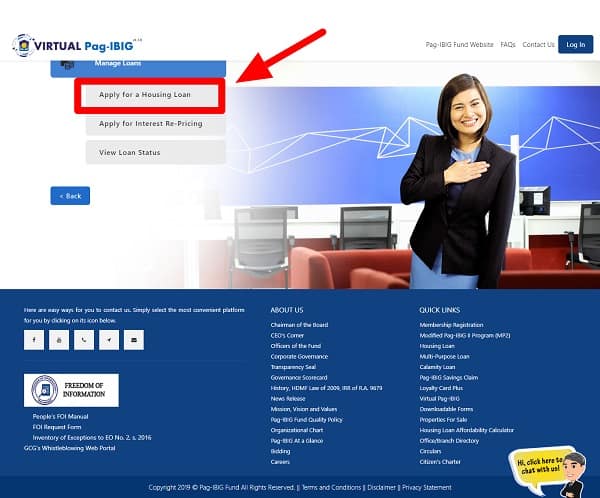
If you don’t have a Virtual Pag-IBIG account yet, here’s a step-by-step guide on how to create one. With this innovation, you can now submit your housing loan application online and schedule an appointment with the nearest Pag-IBIG office which will process your application.
Here’s how to do it:
Here’s how to do it:
1. Go to the Virtual Pag-IBIG website.
2. Click Apply for and Manage Loans.
3. Select Apply for a Housing Loan from the list of options.
4. Once you’re on the Online Housing Loan Application page, check the list of requirements before you continue. Click Proceed.
5. From the drop-down list, select the loan type that applies to you.
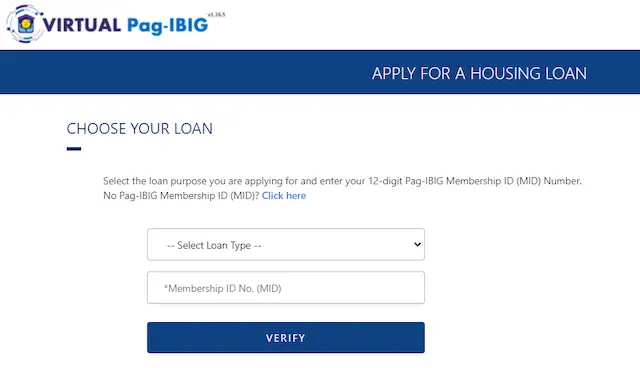
6. Next, enter your 12-digit Pag-IBIG Membership ID (MID) and click on Verify.
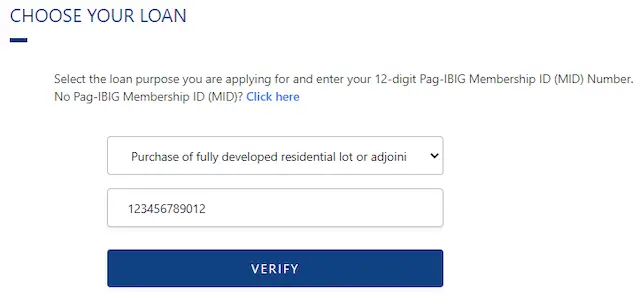
Another application form will appear.
Fill out the online application form with the requested information, which includes:
- Loan information like the purpose of the loan, mode of payment, desired loan term, desired re-pricing period, etc.
- Personal information like your e-mail address, cell phone number, home ownership, years of stay in present home address, occupation, years in employment or business, number of dependents, gross monthly income, etc.
- Preferred Pag IBIG branch office where you’ll submit the application form and housing loan requirements.
Once you’re done, click Submit.
You will then receive a reference number or Housing Loan Application Tracking Number via SMS. Pag IBIG will also send you through e-mail the schedule of your appointment, the address of the Pag IBIG office, and the Pag IBIG Fund contact person you’ll be transacting with.
Option 2: Over-the-Counter Application
All applicants are required to file their Pag IBIG housing loan applications personally at:
- For NCR/Metro Manila applicants: Servicing Department, 2/F JELP Business Solutions, 409 Shaw Blvd., Mandaluyong City; or at any Pag-IBIG branch office.
- For provincial applicants: Pag-IBIG branch office nearest you.
Here are the things you should expect to accomplish upon arriving at the Pag IBIG branch office:
1. Submit two copies of the application form and the rest of the documentary requirements to any of these counters: Members Services Support Division-Servicing Department, Loans Origination-Housing Business Center, or Members Services Branch.
2. Pay the required processing and appraisal fees (see the list of requirements in the previous section) plus the lump sum payment of membership savings (if applicable) at the Cash-Collection Division-Loans Support Services Department/Members Services. Don’t forget to get the Pag IBIG Fund Receipt.
3. Submit the receipt to the Members Services Support Division-Servicing Department/Loans Origination-Housing Business Center/Members Services Branch servicing counter, which will then give you the Housing Loan Application Acknowledgement Receipt (HLAAR).
6. Wait for the Approval of Your Pag IBIG Housing Loan

Pag IBIG will notify you regarding the status of your housing loan application within 17 days.
In case you get denied, you’ll receive a Notice of Disapproval (NOD) along with your loan documents.
If your application is approved, expect a call from Pag IBIG informing you when you can pick up the Notice of Approval (NOA) and Letter of Guaranty (LOG).
Let’s summarize the procedures you’ll go through after getting approved:
a. Receive the Notice of Approval (NOA) and Letter of Guaranty (LOG)
Take note that LOG is not applicable to housing loans intended for house construction or home improvement.
Only the borrower can receive the NOA. For OFWs who can’t make it home to personally receive the NOA, Pag IBIG can release it to the authorized representative/Attorney-in-Fact provided that there’s a notarized Special Power of Attorney (SPA).
b. Sign your loan documents
After receiving the NOA and LOG from the Pag IBIG, go straight to the Members Services Support Division-Servicing Department/Loans Origination-Housing Business Center/Members Services Branch servicing counter.
There, a Pag IBIG officer will discuss your loan obligations as well as the terms and conditions of the following loan documents:
- Disclosure Statement on Loan Transaction (DSLT)
- Loan and Mortgage Agreement (LMA)
- Promissory Note (PN)
Once you’ve fully understood their content, affix your signature to these documents. If you’re borrowing with your spouse or a co-borrower, both of you need to sign the documents.
c. Complete your NOA requirements for check release
At this point, the only thing standing between you and the release of the Pag IBIG housing loan is the list of requirements in the Notice of Approval.
The complete NOA requirements must be submitted within 90 days, or else you won’t get the check and will receive a Notice of Deficiency instead.
All documentary requirements must be notarized at the place or city where they are executed.
The process of completing the NOA requirements vary depending on the purpose of the housing loan. To give you an idea, please check out the following checklists:
For Purchase of Lot/Condominium Unit/House & Lot
- Give the LOG to the seller.
- Proceed to the BIR for payment of Capital Gains Tax and Documentary Stamp Tax. The BIR will issue the Certificate Authorizing Registration.
- Proceed to the Local Government Unit (LGU) for payment of Transfer Tax.
- Proceed to the Registry of Deeds (RD) for the transfer of the title and annotation of the mortgage.
- Proceed to the LGU for the transfer of the Tax Declaration.
- Submit complete requirements to Pag IBIG Fund.
For Purchase of House and Lot Mortgaged with Pag IBIG Fund
- Proceed to the BIR for payment of Capital Gains Tax and Documentary Stamp Tax. The BIR will issue the Certificate Authorizing Registration.
- Proceed to the Local Government Unit (LGU) for payment of Transfer Tax.
- Go to the Pag IBIG office to schedule a trip to the Registry of Deeds (RD) for the transfer of title and annotation of the mortgage.
- Proceed to the LGU for the transfer of the Tax Declaration.
- Submit complete requirements to Pag IBIG Fund.
For the Construction of House/Home Improvement
- Proceed to the BIR for payment of Documentary Stamp Tax.
- Proceed to the Registry of Deeds (RD) for annotation of the mortgage.
- Submit complete requirements to Pag IBIG Fund.
For Refinancing
- Proceed to the bank/financing institution to give the Letter of Guaranty (LOG) and Loan and Mortgage Agreement (LMA).
- Proceed to the Registry of Deeds (RD) for annotation of the mortgage.
- Submit complete Requirements to Pag IBIG Fund.
7. Claim Your Check/Loan Proceeds at the Pag IBIG Fund

Once the check is available for pick-up, you’ll get another call from Pag IBIG.
To claim the check/loan proceeds, present 2 valid IDs (see requirements section for a list of valid IDs accepted by Pag IBIG) at the Cash-Disbursement Division-Loans Support Services Department/Members Services Branch.
The check can only be released to the borrower or any of the following:
- An authorized representative provided that he/she submits a notarized Special Power of Attorney (SPA) and 2 valid IDs each of the principal borrower and the representative/Attorney-in-Fact.
- The seller, if the loan purpose is one of the following: Purchase of Residential Unit, Lot Purchase, or Purchase of Lot and Construction of House.
The borrower will also be required to bring 12 PDCs (post-dated checks) if the payment is not through salary deduction (see next step for more information).
8. Start Paying Your Monthly Amortization
Amortization is defined as the process of spreading out a loan (in this case, a Pag IBIG housing loan) into a series of fixed payments over time.
It refers to the monthly payments that you’ll make for the next coming months and years to pay off the Pag IBIG housing loan.
There are different ways to pay your monthly amortization:
a. Payment Through Post-Dated Checks (PDCs)
If you choose this, you need to issue and submit 12 post-dated checks to the Pag IBIG Fund upon loan release. These checks will cover 1-year monthly amortization.
Get the Acknowledgment Receipt (AR).
Return to the Pag IBIG upon consumption of the 10 PDCs (exclusive of the remaining 2) to issue another 12 checks.
Always claim and keep the receipts from Pag IBIG each time you issue a check.
b. Payment Through Salary Deduction
If you opt for amortization payment via salary deduction (as most Filipino employees do), you need to submit Authority to Deduct to the Billing Division/Accounts Management and Billing Department/Loans Management and RecoveryHousing Business Center/Members Services Branch.
Upon loan takeout, an equivalent of one-month amortization will be deducted from the loan proceeds.
c. Other Modes of Payment
- Auto debit arrangement with banks.
- Accredited collection partners (available for both local and overseas remittance).
- Payment to an accredited developer with a Collection Servicing Agreement with the Pag IBIG Fund.
- Other methods of payment that the Pag IBIG Fund may implement in the future.
Tips and Warnings
a. While we try our best to answer all possible questions in this guide, you should also be on the lookout for the latest schedules of the Pag IBIG Housing Loan orientation program on their Facebook page.
In this program, which is conducted several times a year in specific Pag IBIG branches and venues, you can address your concerns directly to the Pag IBIG personnel.
b. Just like when you’re applying for a credit card, your credit score may also be reviewed during the evaluation of your Pag IBIG housing loan application.
A credit score contains vital personal information as well as your past financial transactions with banks and lending institutions.
Make sure your credit score is up-to-date, accurate, and isn’t tarnished by unpaid debts. You can secure a free copy of your credit score from the Credit Information Corporation (CIC) or any of its accredited credit bureaus.
c. Don’t go to Pag IBIG empty-handed. Before applying for a housing loan, you should already have saved up at least 20% of the property’s value for the down payment.
The higher the down payment you can afford, the more likely your housing loan application will get approved. It can also lower your interest rate, monthly mortgage, loan-to-value ratio, and loan term.
d. For the employed, the key to getting approved is to show you have a solid employment history. Job hopping and gaps in your employment history may be seen as red flags. Employment tenure means income stability and the capability to pay off your housing loan.
e. If you’re afraid you might not be qualified due to insufficient income, convince someone with a regular job and good credit history to take you as a co-borrower.
Pag IBIG allows a principal borrower to share the housing loan with up to two co-borrowers who can be a relative or not.
f. Carefully assess your current income and determine how much of it you can set aside for monthly amortization. Ideally, the loan amount shouldn’t exceed your three-year salary, while your mortgage or monthly amortization shouldn’t go beyond 20-30% of your gross monthly income.
Use the Pag IBIG’s housing loan affordability calculator to help estimate the loan amount and monthly amortization based on your income and other factors.
g. If you’re investing money to prepare for your housing loan13, it’s best to put them in investment vehicles with conservative risks and insured by the Philippine Deposit Insurance Commission, such as Pag-IBIG P1 and MP2, cooperative time deposits with at least 10 years of operation, and rural bank deposits. Government bonds are also recommended since they have low default risk. Refrain from investing money in volatile investment vehicles like stocks, cryptocurrencies, or NFTs. It’s difficult to regain lost amounts in these financial instruments since they are not covered by deposit insurance.
h. If possible, your loaned (or purchased) house should not comprise as high as 50% of your total assets. Make sure its share in your total assets decreases over time by acquiring other real properties or investing in different financial instruments14.
i. As much as possible, limit your loan term to a maximum of 20 years. Loan term beyond this period increases the risk of you financing the loan until your retirement. It’s better that you’re free from any debt, especially at an old age.
j. The total monetary value of the house (sum of all amortized payments) should not exceed your (and your partner’s combined) three-year income. This is to ensure that the loan amortization is not beyond your subsistence and to prevent any difficulties in loan repayment.
k. If in the future you find that you need to renegotiate your housing loan terms, you can apply for a loan restructuring at Pag-IBIG’s Special Housing Loan Restructuring Program page. Compared to the 7.75% per annum interest rate for the regular Housing Loan Restructuring Program, the special program only has an interest rate of 6.375% per annum on a 1-year fixing period. This special program was created to help Filipinos during the ongoing COVID-19 situation.
Comments
Post a Comment